Technology 9 min read
Scaling Your Business App as Your Company Grows
The 5 signals your tool needs to evolve, extensible architecture principles, and an 18-month feature roadmap.
Table of contents9
Your company had 15 people when your business application was built. Today it has 40. Data volume has tripled, processes have changed, and teams that didn't exist back then now use the tool every day. The question is no longer "does the tool work?" but "can it keep up with our growth?"
Many leaders find out late: a custom business tool isn't a finished product. It's a living asset that has to evolve at the same pace as the company. Otherwise it turns from a growth lever into an operational bottleneck, and the hours saved at launch get lost again in workarounds.
This guide explains how to anticipate, plan and deliver your business app's evolution without rebuilding from scratch, interrupting operations or blowing your budget.
Key takeaways
- 5 signals tell you it's time to evolve the tool: slowdowns, changed processes, more users, unmanageable data, new tools to connect.
- A modular, open architecture planned from the start makes every change faster and cheaper.
- An 18-month roadmap, reviewed every quarter, stops you from reacting to one emergency after another.
- In most cases, evolving what you have beats rebuilding.
- Growth multiplies repetitive tasks: it's the moment to automate rather than hire people to re-key data.
The 5 signals it's time to evolve your tool
Your app sends signals before it becomes a drag. Spotting them early means anticipating rather than suffering. The "benchmarks" below are practical thresholds, not standards.
1. Response times are degrading
Screens that loaded in a second now take several. Dashboards are slow, searches drag. The database has grown, but the architecture wasn't optimized for that volume.
Benchmark: beyond 3 seconds on everyday screens, optimization is needed.
2. Processes have changed but the tool hasn't
You've launched a new service line, created a department or changed your pricing. The tool still enforces the old process, and your team works around it with side spreadsheets.
Benchmark: as soon as a whole team keeps a parallel file to make up for a limitation.
3. User numbers have doubled
The tool was built for 10 concurrent users; you now have 25. Performance drops at peak times, access conflicts multiply, some features aren't designed for multi-team work.
Benchmark: systematic slowdowns reported at the same times of day.
4. Data is becoming unmanageable
Your database holds years of history, thousands of files and millions of rows. Exports drag, reports are incomplete, storage balloons.
Benchmark: when generating a monthly report takes more than a few minutes.
5. New integrations are needed
You've switched CRM, added a communication tool or adopted new accounting software. The app isn't connected to them and re-entry creeps back. Mandatory e-invoicing, now rolling out across the EU, often adds another connection to plan.
Benchmark: as soon as your team re-enters data between two unconnected tools.
If you recognize at least 2 of these signals, it's time to plan an evolution. A 30-minute assessment identifies the priorities; ongoing work continues through our support plans.
Extensible architecture: planning for growth from day one
The best way to handle evolution is to plan for it at the design stage. An extensible architecture doesn't cost much more up front, and it costs far less to evolve.
The 4 principles of extensible architecture
- Modularity: the app is made of independent modules. Adding one doesn't mean rewriting the others.
- Extensible database: the data model can take on new entities without restructuring; custom fields are planned for.
- Open connections: data exchange points are built in from the start for future integrations, without touching the core. See also our open architecture guide.
- Interface and business logic kept separate: changing one doesn't affect the other.
What this means in practice
Indicative orders of magnitude:
| Scenario | Rigid architecture | Extensible architecture |
|---|---|---|
| Add a module | Partial rewrite, several weeks | Targeted addition, one to two weeks |
| New integration | Core changes, risk of breaking things | Plug into a planned connection |
| Double the users | Rework part of the architecture | Adjust hosting |
| New complex report | Heavy development | Combine existing data, a few days |
At Iselia Projects, modular architecture is our standard: every project is designed to take on new modules and connections without a rebuild. The principle is set from the requirements document onward.
The feature roadmap: planning changes over 18 months
Rather than reacting to emergencies, plan your changes. An 18-month roadmap gives visibility and lets you budget calmly.
Quarter 1: stabilization (months 1 to 3)
- Fix the irritants reported by users
- Optimize performance if needed
- Additional team training
- Initial ROI measurement
Quarter 2: enrichment (months 4 to 6)
- Add the 2 or 3 most requested features
- First third-party integration (accounting or CRM)
- Roll out priority automations
- Performance review at 6 months
Quarters 3 and 4: expansion (months 7 to 12)
- Open the tool to new teams or user profiles
- Additional integrations
- Advanced reporting module
- First full review of hours recovered
Quarters 5 and 6: optimization (months 13 to 18)
- More complex automations (scheduling, forecasting)
- Usability improvements on the most-used modules, based on usage data
- Technical modernization if needed
- Preparing the next growth phase
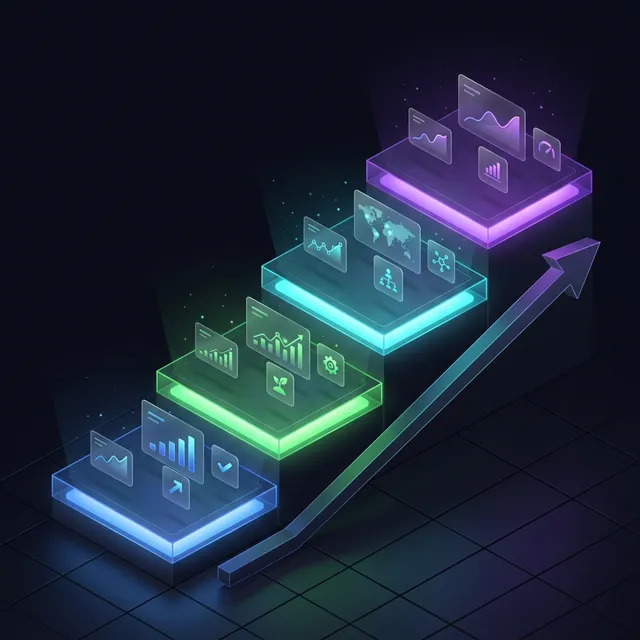
Growth: automate rather than hire to re-key
When activity doubles, repetitive tasks double too: more quotes, schedules, reminders, reports. Without automation, the only answer is hiring people to absorb data entry. With an app that evolves, those tasks can be taken over as they appear.
At Iselia Projects, every change is prioritized by the hours it gives back to the team. For a transport and logistics company, for instance, route allocation, delivery notifications and proof of delivery are often the first things automated; that's the scope of our scheduling & operations automation. To quantify the repetitive work your growth is adding, use the time savings calculator.
Comparison: evolve or rebuild
| Criteria | Evolve | Rebuild |
|---|---|---|
| Extensible architecture in place | Recommended | Unnecessary |
| Undocumented code | Audit first | Often necessary |
| Technology no longer maintained | Costly | Recommended |
| Fundamental change in business model | Risky | Recommended |
| Limited budget | The only realistic option | Difficult |
| Short deadline (under 2 months) | Feasible | Unrealistic |
| Cost | Moderate, in stages | High, all at once |
| Timeline | A few weeks per change | Several months |
In most cases, evolving is the right answer. A rebuild is justified when the original architecture can't be repaired or the business model has fundamentally changed.
Illustrative scenario: two years of evolution for a logistics tool
Illustrative scenario built on assumptions: not an actual client, and the figures are examples.
Profile: logistics company, 22 people at launch, 48 two years later.
Launch (month 0): delivery management app (scheduling, real-time tracking, invoicing). 8 drivers, 150 deliveries a day. Budget: €32,000.
Month 6: accounting integration and team notifications. Cost: €3,500. Goal: stop re-entering delivery notes into accounting.
Month 10: the fleet doubles (16 drivers). Database optimization and an automated scheduling module. Cost: €6,000. Goal: much faster daily dispatching.
Month 14: a second depot opens. Multi-site module added. Cost: €4,500, with no rework of the app's core.
Month 20: advanced dashboards and volume forecasting. Cost: €5,000.
Scenario totals after 2 years:
- Total budget: €32,000 + €19,000 = €51,000
- Volume handled: 450 deliveries a day (×3)
- Team: 48 people (×2.2)
- No rebuild: the modular architecture absorbed the growth.
Our scalability approach at Iselia Projects
At Iselia Projects, scalability is built in from day one:
- Modular architecture from the first version: even for an MVP, the foundations are designed for growth
- Shared roadmap: an evolution plan built with you and reviewed regularly
- Monitoring: maintenance includes performance tracking and alerts
- Progressive changes: instead of massive rebuilds, improvements of a few weeks each
- Predictable budget: every change is priced before it starts
To choose the partner who will support your growth, see our selection guide.

Frequently Asked Questions
How much does evolving an existing business application cost?
As a rough guide, a few thousand euros per module added or changed, far less than a full rebuild. The cost depends mainly on the quality of the original architecture: an extensible architecture sharply reduces the cost of each change.
My app was built by another vendor. Can it be evolved?
Yes, with conditions. You need the source code, technical documentation and server access. A preliminary audit assesses the state of the code and the effort to take it over. If the architecture is sound, evolving it is entirely viable.
How often should changes be planned?
Ideally on a quarterly cycle: a review every 3 months to identify needs, prioritize and plan. Changes are then delivered within a few weeks depending on complexity. This rhythm avoids a backlog building up and the need for big rebuilds.
How do I know if my application can handle more users?
A load test simulates many concurrent users and measures response times. If they stay good at double your current user count, the infrastructure is enough. If not, an adjustment, often a simple one, is needed.
Does evolving the app require downtime?
No. Changes can go live without service interruption, through progressive releases. Your team keeps working normally. Any serious vendor should master this.
When should I rebuild rather than evolve?
Mainly in three cases: technologies that are no longer maintained, an undocumented monolithic architecture, or a fundamental change in the business model. Otherwise, evolving is faster, less risky and cheaper.
Conclusion: growth is prepared, not improvised
Your business application is a strategic investment. Like any asset, it needs upkeep and regular improvement to keep, and grow, its value.
The 5 warning signals, the 18-month roadmap and the extensible architecture covered here let you anticipate growth, and use it as the moment to automate what costs you the most time.
Is your app showing signs of strain as you grow? At Iselia Projects, the assessment is free and with no commitment: in 30 minutes, we review your repetitive tasks and your tools, then estimate the hours you could get back. You can also book a call directly. Book your free assessment →
Go further
From this guide to your hours
- Automation Custom business tools Internal apps, client portals, dashboards and automated reports designed for your industry and connected to your data — you own the code.
- Calculator Estimate my hours back Free calculator: your tasks, your volumes, an indicative estimate of the hours saved.
- Support Support plans Monitoring, maintenance and improvements of your automations after go-live.