Strategy 11 min read
Security and GDPR for Your Business App: The SME Guide
How to secure your business app and comply with GDPR. 7 pillars, compliance checklist, and best practices for SMEs.
Table of contents8
SMEs aren't too small to be attacked — they're often targeted precisely because they're less protected. Ransomware, phishing, exploitation of unpatched software: national cybersecurity agencies such as France's ANSSI regularly point this out. At the same time, GDPR places specific obligations on any business that processes client or employee data, enforced by data protection authorities. For an SME running a business application, security and compliance are no longer optional.
This article gives you the practical keys to secure your business application and comply with GDPR without becoming a cybersecurity expert: concrete measures you can apply today.
Key takeaways
- Security is a business risk that leadership owns: downtime, data loss, damaged trust, and possible penalties.
- Seven pillars cover the essentials: strong authentication, access rights, encryption, tested backups, protection against common attacks, monitoring, and continuous updates.
- GDPR: a legal basis and purpose for each processing activity, minimized data, defined retention periods, tooling for data subject rights, and notification to the authority within 72 hours for risky breaches.
- Transfers to the US have relied since July 2023 on the EU-US Data Privacy Framework; European hosting remains the simplest option for sensitive data.
- Fewer manual steps also means less risk: every Excel export sent by email is one more copy of your data.
Why Security Is a Leadership Issue
IT security isn't a technical topic reserved for the IT team. It's a business risk that leaders must manage alongside financial and legal risk.
3 Impacts of a Security Breach for an SME
- Financial impact — Downtime, data to rebuild, expert intervention, possibly a ransom demand (which authorities advise not to pay): the bill can be heavy for an SME, before counting lost revenue
- Impact on trust — A data leak directly affects your clients. For an SME, trust is the primary commercial asset
- Legal impact — GDPR provides for fines of up to €20 million or 4% of worldwide annual turnover (whichever is higher) for the most serious violations. Authorities also inspect small businesses
Building security in from the start costs far less than repairing after an incident. It's one of the few areas where prevention almost always pays.
Foreign SaaS vs Custom Tool: Where Is Your Data?
When you use online software from a US company (CRM, project management, file storage), your data may be hosted in the United States, or in Europe by a company subject to US law (notably the CLOUD Act).
The framework has changed: after the EU Court of Justice invalidated Privacy Shield (Schrems II, 2020), the European Commission adopted an adequacy decision for the EU-US Data Privacy Framework in July 2023. Transfers to certified US companies are therefore possible, but the framework remains contested and the question of access by foreign authorities hasn't gone away. For sensitive data, hosting in Europe with a provider subject only to European law remains the easiest option to justify.
What a Custom Tool Hosted in Europe Brings
| Criteria | Online software from a US vendor | Custom tool (EU-hosted) |
|---|---|---|
| Data location | US or Europe depending on the plan | France / Europe, chosen and written into the contract |
| Access by foreign authorities | Possible depending on the law applying to the vendor | Limited to the European legal framework if the host is subject only to it |
| GDPR compliance | To be documented (Data Privacy Framework, standard clauses) | Designed in from the start |
| Backup control | Limited (depends on the provider) | Full (you choose frequency and location) |
| Data ownership | Check the terms of service | Full, written into the contract |
For a broader look at why custom tools offer better control than generic solutions, read our comparative analysis.
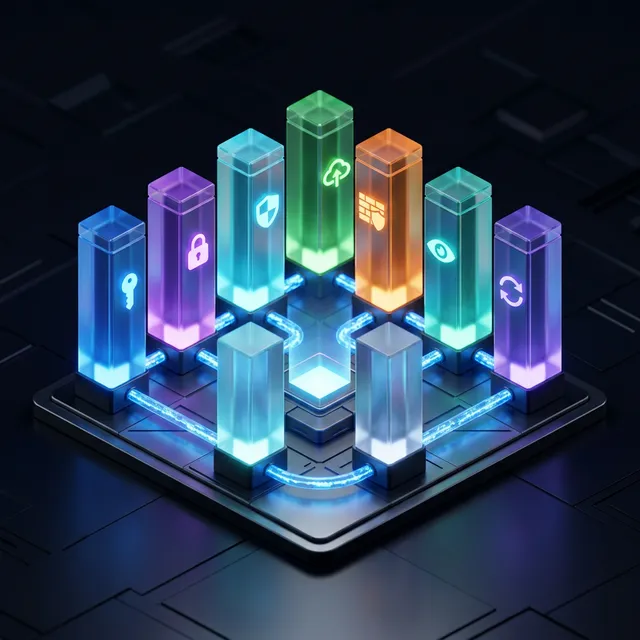
The 7 Pillars of Business Application Security
Business application security rests on 7 foundations that any serious development partner must build in from the design phase — not after go-live.
1. Secure Authentication
Every user must be reliably identified before accessing the application:
- Strong passwords — At least 12 characters of several types, stored hashed, never in plain text
- Multi-factor authentication — A temporary code from an authenticator app or a security key. According to Microsoft (2019), multi-factor authentication blocks the vast majority of account compromise attacks
- Lockout after repeated failures — Access is temporarily blocked after a few unsuccessful attempts
2. Access Rights Management
Each user should only see and modify what concerns them:
- Defined roles — Administrator, manager, operator, client: each role has specific permissions
- Least privilege — Users only access the data strictly necessary for their work
- Audit logging — Every sensitive action (change, deletion, export) is recorded and timestamped
3. Data Encryption
Data must be unreadable if intercepted:
- In transit — All communication between the browser and the server is encrypted (HTTPS)
- At rest — Stored data is encrypted, as are backups
4. Automated Backups
Data loss is a permanent risk:
- Daily backups — Automatic, encrypted, stored at a separate site
- Restoration tests — An untested backup is worthless: test restoration at least quarterly
- History — The ability to roll back (for example over 30 days) after corruption or ransomware
5. Protection Against Common Attacks
Web applications face well-known attacks (catalogued in the OWASP Top 10):
- Code injection — Malicious data entered through forms to reach the database. Countered by systematic input validation
- Request forgery — Requests sent on behalf of a legitimate user. Countered by unique security tokens
- Denial of service — A flood of requests to make the application unavailable. Countered by rate limiting and a web application firewall
6. Monitoring and Alerts
Early detection is the best defense:
- Continuous monitoring — Response times, error rates, suspicious login attempts
- Automatic alerts — Notification of anomalies (traffic spikes, server errors, unauthorized access attempts)
- Regular reports — Summary of security status and actions taken
7. Continuous Security Updates
Security isn't a state — it's a process:
- Patches — Prompt application of security updates to software components
- Annual review — A full review of configuration and access
- Watch — Tracking new vulnerabilities affecting the technologies in use
GDPR: What Your Application Must Comply With
The GDPR (General Data Protection Regulation) applies to any application that processes personal data of people in the European Union — clients, employees, or prospects.
The 6 Key Obligations
| Obligation | In Practice | Impact on Your Application |
|---|---|---|
| Legal basis | Each processing activity rests on one of 6 bases (contract, legal obligation, legitimate interest, consent…) | Where consent is required, it's collected with an unticked checkbox |
| Purpose limitation | Data is only collected for a specific, documented reason | No "just in case" fields: every data point has a justification |
| Data minimization | Only collect what's strictly necessary | Fewer fields = fewer risks |
| Retention period | A period is set for each purpose (for example, France's CNIL recommends 3 years after last contact for prospects) | Automatic archiving or deletion when it expires |
| Data subject rights | Access, rectification, erasure, portability, objection | Built-in export and deletion features |
| Breach notification | A breach posing a risk must be notified to the authority within 72 hours | Documented, tested procedure |
GDPR "by Design" vs GDPR Added After the Fact
The difference is fundamental:
- By design (GDPR Article 25) — Compliance is built into the architecture from day one: encryption, retention periods, access rights, logging. The extra cost stays moderate
- Added after the fact — The application exists and must be made compliant retroactively. Changes are heavier, riskier, and more expensive, with no guarantee of full coverage
And if your application includes AI features, the EU AI Act adds transparency obligations that apply in principle from 2 August 2026 — for example, telling people they're interacting with an AI system.
At Iselia Projects, GDPR is considered from the design phase. Our support plans then cover security updates and ongoing care.
Security and Automation: Fewer Manual Steps, Fewer Risks
It's easy to forget: many data leaks come from manual handling. A client export sent by email, an Excel file copied to a USB stick, an ID document sitting in a shared inbox. Every extra copy is extra exposure.
Automating how documents and data move — with precise access rights and a log of every action — reduces both these risks and the time spent handling them. It matters especially in confidentiality-bound professions such as law firms, where reading and filing documents can be automated without them ever leaving the secure environment. See our documents and admin page, and estimate the time involved with the time savings calculator.
What to Verify with Your Development Partner
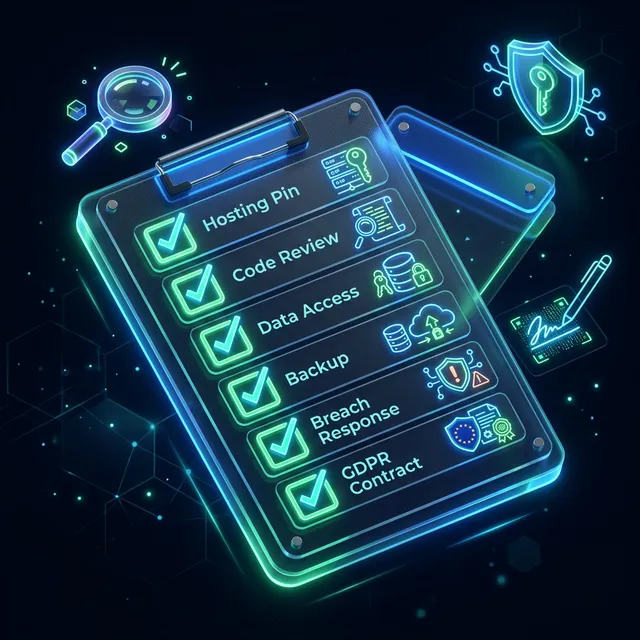
When you entrust your business app to a partner, ask these questions before signing:
- Where will my data be hosted? — The answer must be specific: country, host, region, applicable law
- Is the code reviewed regularly? — A serious partner runs security reviews and applies patches promptly
- Who can access my production data? — Only those strictly necessary, with traceability
- How are backups handled? — Frequency, encryption, storage location, tested restoration procedure
- What happens if there's a breach? — Response time, notification procedure, remediation plan
- Does the contract include a GDPR clause? — A data processing agreement (Article 28) must be signed
To evaluate a partner beyond security, see our article on choosing a development partner. To estimate the budget, our development cost guide details the line items.
Frequently Asked Questions
How much does it cost to secure a business application?
Built in from the design phase, security adds a moderate cost: a few thousand euros for a typical management application, depending on requirements (multi-factor authentication, logging, encryption, security review). That's nothing compared to the cost of an incident: downtime, data reconstruction, notification, lost clients.
Does my application need to be GDPR-compliant even if it's internal?
Yes. As soon as your application processes employees' personal data (names, emails, phone numbers, absences), it's subject to GDPR. The principles are the same for client data and internal data.
Do I have to host data in my own country?
No. GDPR doesn't require national hosting. Data can be hosted in the European Economic Area, or transferred to a country covered by an adequacy decision (or with appropriate safeguards). Some data has specific rules: in France, health data hosted by a third party must sit with an HDS-certified host. At Iselia Projects, European hosting is our default.
What is "security by design"?
It means building protection into the application's architecture from the start, not afterward: encryption, authentication, access management, logging, data minimization. It's more effective, cheaper in the long run, and a requirement of GDPR Article 25 (data protection by design and by default).
Is my development partner responsible in case of a data breach?
Partly. GDPR distinguishes the controller (you, the company) from the processor (the partner). The processor has its own obligations (security, confidentiality, notifying the controller), but you remain responsible for the processing you decide on. The data processing agreement (Article 28) sets out each party's obligations — and it's mandatory.
How can I verify that my application is secure?
Through a security audit or penetration test carried out by a specialist. It checks server configuration, application protections, password handling, encryption, and backups. Cost depends on scope. An annual review, plus an audit after any major change, is good practice.
Conclusion: Security Is an Investment — Not a Luxury
Securing a business application and ensuring GDPR compliance means protecting your company, your clients, and your reputation. Built in from development, security costs far less than the incidents it prevents.
GDPR compliance isn't just red tape — it's also a trust signal. SMEs that can demonstrate serious data protection reassure increasingly demanding clients.
Is your current application secure and compliant? At Iselia Projects, the assessment is free and with no commitment: in 30 minutes, we review your repetitive tasks and your tools, then estimate the hours you could get back. Book your free assessment →
Go further
From this guide to your hours
- Automation Custom business tools Internal apps, client portals, dashboards and automated reports designed for your industry and connected to your data — you own the code.
- Calculator Estimate my hours back Free calculator: your tasks, your volumes, an indicative estimate of the hours saved.
- Support Support plans Monitoring, maintenance and improvements of your automations after go-live.